Fastener failure in industrial machinery, automotive assemblies, and structural engineering is rarely a simple material flaw. It is typically a dangerous loss of preload. Constant vibration, severe thermal cycling, and heavy dynamic loads often cause this hidden issue. Standard hex nuts rely entirely on tension and friction against the bearing surface to hold joints together. When environmental forces cause tension to drop, the nut inevitably backs off. You face severe safety risks and equipment damage when these basic fasteners fail under pressure.
This guide defines the precise mechanical mechanisms behind different lock nut designs. You will discover a clear framework for specifying the correct fastener. We evaluate environmental extremes, maintenance intervals, and vibration severity to ensure you build reliable assemblies. You will learn to match specific locking mechanisms to your exact load profiles and operating environments.
Key Takeaways
Environmental temperature dictates the primary material choice: non-metallic inserts fail in high-heat applications, requiring all-metal alternatives.
"Prevailing torque" nuts provide continuous resistance during installation and removal, actively fighting vibration loosening.
Mechanical locking methods (e.g., slotted nuts with pins) offer the highest removal resistance but require more complex, manual installation.
Proper torque calculations for a lock nut must account for the additional friction generated by the locking mechanism itself.
The Engineering Problem: Why Standard Nuts Fail
Engineers often trust standard hex nuts for static loads. Dynamic environments completely change this equation. Standard nuts fail because they lack internal retention mechanisms. They depend entirely on clamp load to maintain friction. If clamp load decreases, friction vanishes.
The Mechanics of Loosening
Transverse vibration is the primary enemy of threaded joints. Side-to-side forces cause microscopic slippage between mating threads. This lateral movement temporarily separates the thread flanks. The nut gradually unwinds during these split-second separations. You lose joint integrity as the standard hex nut rotates backward along the bolt thread. Thermal expansion and contraction further exacerbate this unwinding process. Materials shift slightly during temperature changes, releasing built-up tension.
The Limitation of Washers
Many assemblies attempt to solve vibration loosening by adding washers. Split-ring lock washers or tooth lock washers add initial tension. However, they possess significant mechanical limitations. High clamp loads often flatten split-ring washers entirely. They function just like standard flat washers once flattened. Tooth lock washers frequently score mating surfaces during installation. This scoring damages protective coatings and accelerates corrosion. Integrated locking nuts provide a substantially more reliable engineering choice.
Success Criteria for Fastening
You must define success clearly for critical joints. A successful joint requires maintaining optimal clamp load constantly. It must resist specific dynamic forces present in your application environment. Vibration frequencies, shock loads, and thermal shifts dictate your fastener choice. You cannot afford arbitrary selection. Every joint demands a calculated approach to prevent catastrophic relaxation.
Primary Categories: Friction vs. Thread Deformation
Engineers categorize self-locking fasteners by their retention mechanism. The two dominant designs utilize either friction-based polymer inserts or deformed metal threads. Each category solves the vibration problem differently.
The Nylon Insert Lock Nut (Nyloc)
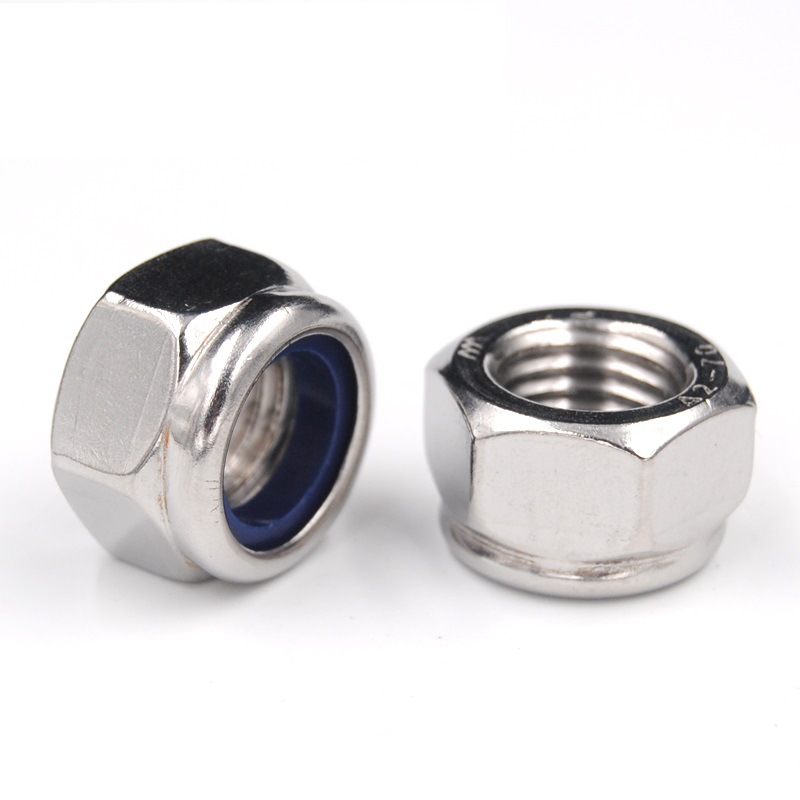
The nylon insert lock nut represents the standard for light to medium industrial applications. It features an integrated, undersized polymer collar located at the top of the nut.
Mechanism: The mating bolt threads force their way into the undersized polymer collar during installation. The nylon material deforms plastically over the metal threads. This creates a tight, compressive friction fit. The collar grips the bolt continuously. It provides constant resistance against backward rotation.
Advantages: You gain excellent dampening characteristics against severe vibration. The nylon absorbs high-frequency micro-movements. It also creates an effective gas and moisture seal over the thread interface. This seal prevents aggressive corrosion from forming deep inside the joint.
Limitations: Polymer inserts have strict temperature ceilings. Nylon typically degrades rapidly above 250°F (121°C). The locking mechanism fails entirely once the polymer melts or hardens. You must also evaluate chemical exposure. Certain industrial solvents and acids degrade the nylon collar prematurely.
The All-Metal Lock Nut (Prevailing Torque)
Extreme environments require heavier-duty solutions. You should specify an all-metal lock nut for high-temperature or highly corrosive zones.
Mechanism: This design relies on engineered physical distortion. Manufacturers distort the top threads (top-lock) or side threads (center-lock) slightly out of round. The deformed threads force themselves into alignment when threaded onto a standard bolt. This interference creates immense metal-on-metal friction. It grips the bolt tightly.
Advantages: Metal fasteners withstand extreme temperatures effortlessly. They survive aggressive chemical environments where polymers disintegrate. They provide reliable security for engine manifolds, heavy rail assemblies, and aerospace components.
Limitations: You face a high risk of thread galling. Stainless steel variants are particularly susceptible to cold-welding during installation. You must follow strict lubrication protocols. Accurate torque-down procedures are mandatory to prevent joint destruction.
Specialty Variants for Specific Load Profiles
Standard lock nuts cannot cover every structural scenario. Many applications present unique geometric or safety constraints. Specialized variants address these exact challenges.
The Flange Lock Nut
Heavy machinery and automotive frames often require load distribution. A standard hex nut focuses too much pressure on a small footprint. The flange lock nut solves this problem elegantly.
Mechanism: This fastener incorporates a wide base directly into its design. The extended flange distributes the clamping load over a significantly larger surface area. Many variants feature serrations on the bearing face. These serrations bite into the mating surface to prevent counter-rotation.
Best For: Use these when spanning oversized or slotted holes. They excel in applications requiring high clamp loads on softer mating materials. You can secure aluminum or composite panels without utilizing a secondary washer. This streamlines assembly lines and reduces component counts.
Slotted and Castellated Nuts
Certain joints require absolute guarantees against separation. Preload loss is secondary to preventing total detachment in these scenarios.
Mechanism: These nuts feature distinct slots cut into their tops. You install the nut to the required torque. You then pass a physical barrier through the slots and a pre-drilled hole in the bolt shank. Engineers typically use a cotter pin or safety wire for this barrier.
Best For: Specify these for critical safety assemblies. Wheel hubs, aerospace linkages, and steering components demand them. They provide absolute removal resistance. The joint stays together even if all preload vanishes entirely.
Jam Nuts
Space constraints often eliminate standard prevailing torque nuts. Threaded rod assemblies also present unique challenges.
Mechanism: A jam nut is a low-profile secondary nut. You thread it onto the bolt first. You then install the primary, full-thickness nut. You hold the primary nut stationary while tightening the jam nut backward against it. This creates opposing thread tension. The two nuts lock each other in place.
Best For: They work perfectly for space-constrained applications. Use them on threaded rods or turnbuckles where prevailing torque nuts are impractical. They require operator skill to achieve the correct opposing tension.
Evaluation Framework: Specifying the Right Fastener
Selecting a lock nut requires systematic analysis. You must evaluate the operating environment, maintenance schedules, and assembly requirements. Guesswork leads to joint failure.
Table 1: Lock Nut Selection Matrix
Selection Criteria
Nylon Insert
All-Metal (Distorted)
Slotted / Castellated
Max Temperature
250°F (121°C)
Highly variable (Metal dependent)
Highly variable (Metal dependent)
Vibration Dampening
Excellent
Moderate
Low (Focuses on retention)
Installation Speed
Fast
Medium (Requires careful torque)
Slow (Manual pin alignment)
Reusability
Single-use recommended
Limited cycles
High (Replace pins/wire only)
Temperature & Environment Analysis
Temperature serves as your first hard boundary. Environments below 250°F allow polymer solutions. Nylon inserts are generally preferred here due to their superior vibration dampening. They protect threads from moisture effectively.
Environments exceeding 250°F eliminate polymer options entirely. High-corrosion zones also demand stronger solutions. You must specify all-metal lock nuts for these extremes. Grade C stover nuts or specialized stainless alloys perform reliably under severe duress.
Reusability Requirements
Engineers must carefully assess the joint's maintenance schedule. Self-locking mechanisms degrade over time. Nylon inserts lose their tight grip after multiple cycles. The plastic collar permanently widens. All-metal prevailing torque nuts also wear down the mating bolt threads over time. The metal-on-metal friction physically damages the thread profile.
You must establish strict replacement protocols. Never assume infinite reusability. Discard polymer insert nuts after a single use in critical load paths. Inspect bolts carefully when reusing all-metal lock nuts.
Installation Speed vs. Security
Assembly line efficiency matters significantly. High-volume manufacturing requires rapid fastener installation. Symmetrical center-lock nuts provide a distinct advantage here. Operators or robots can install them either side up. They speed up production lines effortlessly.
Precision or manual assemblies can tolerate slower installation speeds. If security outweighs speed, choose slotted or pinned nuts. The manual alignment of cotter pins takes time. However, the resulting physical barrier guarantees the joint will not detach.
Implementation Risks and Installation Best Practices
Choosing the correct fastener is only the first step. Improper installation ruins even the best engineered joints. You must manage specific mechanical risks during assembly.
Torque Calculation Adjustments
Engineers often make a critical error with prevailing torque nuts. They use standard torque charts. Prevailing torque nuts require extra rotational force just to run down the threads. The locking mechanism resists rotation immediately. We call this resistance "run-down torque."
You must add this run-down torque to your target clamp-load torque. If you ignore this step, you will under-tighten the joint. The wrench will click, but the actual clamp load will remain insufficient.
Mitigating Galling
Galling presents a massive risk during assembly. Friction and heat cause threads to fuse together. We call this cold-welding. You face extreme galling risks when using stainless steel all-metal lock nuts on stainless bolts. The materials bind aggressively.
You must address this specific risk proactively. We recommend using high-quality anti-seize compounds. Alternatively, specify particular fastener platings. Zinc-flake coatings provide excellent lubricity. They reduce friction and prevent cold-welding entirely.
Testing and Validation
Theoretical charts only provide estimates. Real-world assemblies introduce unpredictable variables. Surface finish, lubrication, and tool accuracy all affect final clamp load. We recommend rigorous validation.
Obtain actual production batches of your chosen bolts and lock nuts.
Perform a torque-tension test using a Skidmore-Wilhelm device or similar equipment.
Measure the exact clamp load achieved at specific torque settings.
Adjust your assembly line specifications based on these empirical results.
Relying solely on theoretical charts invites failure. Testing actual components guarantees assembly reliability.
Conclusion
Selecting a lock nut is a complex balance. You must weigh vibration resistance, environmental limits, and installation efficiency carefully. No single fastener solves every engineering challenge.
Evaluate your most extreme operating conditions first, including temperature peaks and specific vibration frequencies.
Define clear maintenance schedules and establish strict single-use policies for prevailing torque nuts.
Calculate installation torque carefully by adding run-down torque to your target preload.
Request sample testing for critical joints before standardizing the Bill of Materials (BOM).
Proactive testing and precise specification prevent catastrophic failures. Secure your assemblies by understanding the mechanics behind the fasteners you choose.
FAQ
Q: What is the difference between a self-locking nut and a lock nut?
A: In industrial procurement, these terms are often used interchangeably. Technically, "self-locking" refers specifically to prevailing torque nuts (nylon or all-metal) that lock without secondary elements. "Lock nut" is a broader category that includes jam nuts and castellated nuts.
Q: Can you reuse a nylon insert lock nut?
A: While technically possible for a very limited number of cycles if the nylon still offers prevailing torque, standard engineering practice dictates replacing them after a single use in critical or safety-rated load paths.
Q: Why is my all-metal lock nut seizing on the bolt before it is fully tightened?
A: This is thread galling, caused by friction and heat during installation. It is common with stainless steel fasteners. Use a slower installation speed and apply an appropriate anti-seize lubricant.