In industrial assembly and structural engineering, specifying an inch hex nut requires more than matching a thread diameter. A slight dimensional variance or incorrect coating tolerance can lead to thread stripping, joint failure, or costly production downtime. You must treat these fasteners as engineered components. While basic size charts are readily available, procurement and engineering teams need to evaluate dimensions against ASME B18.2.2 standards. You must account for material proof loads. You also need to anticipate how platings affect thread fit. A single overlooked tolerance can easily derail an entire production schedule. We will explore everything from spatial clearances to material strength grades. This guide unpacks the technical criteria for evaluating, measuring, and sourcing US standard hex nuts. Read on to ensure precise fit and long-term joint integrity for your next assembly project.
Key Takeaways
Standardization: Authentic SAE inch hex nut dimensions are governed by ASME B18.2.2, directly impacting wrench size and load-bearing capacity.
Tolerance Shifts: Surface coatings (like Hot-Dipped Galvanizing) fundamentally alter internal thread dimensions, requiring oversize tapping to prevent assembly seizure.
Material Matching: Pairing a carbon steel inch hex nut with mismatched bolt grades risks galvanic corrosion and uneven tensile stress distribution.
Procurement Clarity: Utilizing a structured RFQ checklist—specifying nominal size, TPI (UNC/UNF), grade, and finish—eliminates supplier ambiguity.
The Six Critical Dimensions of an Inch Hex Nut
Relying solely on "nominal size" often leads to severe assembly issues. Wrench slippage, inadequate thread engagement, and rejected parts quickly plague the assembly line. Engineering teams must evaluate fasteners using comprehensive dimensional data. ASME standards define the acceptable geometry for these hardware components. You must verify six primary dimensions to guarantee a safe and secure bolted joint.
Nominal Thread Diameter
This represents the internal thread size. Common examples include 1/4" or 1/2". The internal diameter must precisely match the bolt major diameter. Any mismatch prevents proper assembly.
Threads Per Inch (TPI)
TPI dictates the thread pitch distance. UNC (Unified National Coarse) threads allow rapid assembly. They perform best in debris-heavy environments. UNF (Unified National Fine) threads provide superior tensioning. They resist loosening in high-vibration applications.
Width Across Flats (WAF)
This measurement dictates the exact wrench or socket size required for torque application. For example, a standard 1/4 inch hex nut requires a 7/16" wrench. An incorrect flat dimension leads to rounded corners during installation.
Width Across Corners (WAC)
Engineers evaluate WAC for spatial clearance. This dimension matters heavily in recessed environments. Flanged joints also require adequate corner clearance to allow socket access.
Nut Thickness/Height
Thickness directly correlates to the thread engagement area. A thicker nut distributes tensile stress across more internal threads. This parameter determines the ultimate load-bearing capacity of your assembly.
Dimensional Tolerance
Manufacturing processes inherently vary. Tolerance defines the acceptable Min/Max deviation permitted under ASME engineering standards. Components falling outside these bounds risk structural failure.
Nominal Size | TPI (UNC) | Wrench Size (WAF) | Basic Thickness |
1/4" | 20 | 7/16" | 0.226" |
3/8" | 16 | 9/16" | 0.330" |
1/2" | 13 | 3/4" | 0.448" |
SAE Grades and Material Selection for Load-Bearing Projects
Dimensional accuracy only solves half the puzzle. You must evaluate the mechanical properties and environmental resistance of the nut. The fastener must meet or exceed the bolt's tensile strength. Mixing a high-grade bolt with a low-grade nut presents massive implementation risks. Such mismatches result in thread stripping long before the bolt reaches its required preload.
Industry standards classify fasteners by specific grades. SAE grades dictate the internal yield strength and proof load.
Grade 2: Manufacturers use low carbon steel. These components suit non-critical, low-stress applications. The typical proof load hovers around 90,000 psi.
Grade 5: These utilize medium carbon steel. Factories quench and temper them for added strength. They serve automotive and heavy machinery applications well. Expect a proof load near 120,000 psi.
Grade 8: Made from high-strength alloy steel. Engineers specify Grade 8 for extreme structural tensioning. The proof load reaches approximately 150,000 psi.
Material base selection introduces another layer of complexity. A standard carbon steel inch hex nut offers superior raw shear strength. However, it requires surface plating for corrosion resistance. Alternatively, 316 stainless steel sacrifices a small amount of yield strength. In return, it delivers inherent marine-grade corrosion immunity.
You must carefully match bolt and nut materials. Pairing dissimilar metals introduces the risk of galvanic corrosion. This chemical reaction degrades the joint over time. Always specify compatible alloys to ensure even tensile stress distribution and long-term durability.
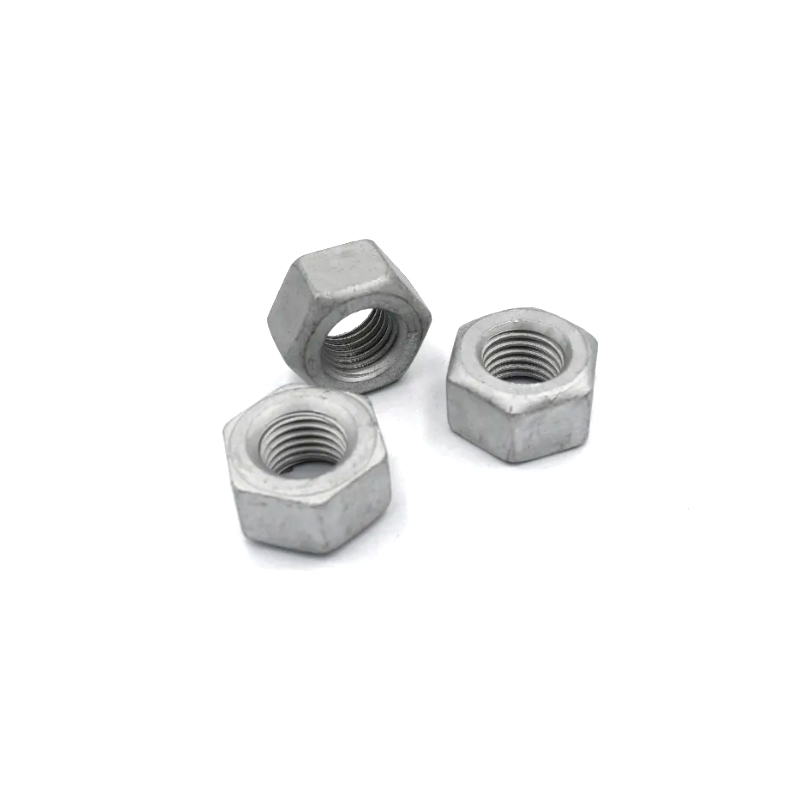
Navigating Thread Fit: How Coatings Alter Inch Hex Nut Tolerances
Specifying a protective finish involves more than aesthetics. Surface treatments change the physical geometry of internal threads. Engineering teams must anticipate these dimensional shifts. When you procure a coated inch hex nut, you must understand how the plating thickness impacts assembly.
Different coatings provide varying levels of protection and geometric interference.
Zinc Plating & Black Oxide
These treatments add minimal micron thickness. The resulting dimensions usually remain within standard tolerance limits. They provide limited sacrificial protection. You can generally use standard mating bolts without issue.
Hot-Dipped Galvanized (HDG)
HDG processes submerge the steel in molten zinc. This adds significant micron thickness to the thread walls. HDG nuts must be tapped oversize after galvanizing. This secondary process accommodates standard HDG bolts. Without oversize tapping, the thick zinc layers bind together. The fasteners will inevitably seize during torque application.
You can mitigate these assembly risks through strict quality control. Mandate "Go/No-Go" gauge inspections post-plating. This inspection verifies allowable thread pitch diameters. Such physical tests ensure the modified dimensions remain within usable ASME tolerances.
Inch vs. Metric Sizing: Avoiding Cross-Standard Assembly Failures
Globalized supply chains heavily mix hardware standards. Facilities often stock both ISO/DIN (metric) and ASME (inch) components. Accidental mixing of these systems leads to catastrophic joint failures. Fastener profiles look deceptively similar to the naked eye. However, their geometries differ fundamentally.
Cross-standard errors present several immediate implementation considerations.
Wrench Fit Failures
Wrench dimensions do not align between systems. Using a metric wrench on an SAE inch hex nut rounds off the corners. The reverse scenario creates the same damage. This mismatch renders the nut impossible to torque to its required specification. Maintenance teams then struggle to remove the damaged hardware later.
Thread Pitch Mismatch
Metric and inch pitch angles diverge significantly. Forcing a metric bolt into an inch nut will cross-thread immediately. This action destroys the internal threads. The joint loses all mechanical holding power.
Standard Verification
Prevent these failures through rigorous documentation. Ensure all prints and Bills of Materials (BOMs) explicitly state the required standard. Call out ASME B18.2.2 for physical dimensions. Call out SAE J995 for mechanical properties. Generic "hex nut" descriptions invite dangerous substitutions.
B2B Procurement: The Inch Hex Nut RFQ Checklist
Inconsistent purchasing specifications cause frequent supplier delays. Vague requirements lead to non-compliant hardware batches. You can eliminate back-and-forth communication by standardizing your Request for Quote (RFQ). A structured checklist forces clarity. It aligns your engineering needs directly with manufacturing capabilities.
Include the following nodes in every hardware RFQ:
Exact Size & Pitch: Never assume a default thread. Specify both diameter and pitch series (e.g., 3/8" - 16 UNC).
Material & Grade: Define the exact mechanical requirement (e.g., SAE Grade 8 Alloy Steel).
Coating/Finish: Specify the treatment clearly. Include required salt-spray resistance hours if the environment demands it (e.g., Yellow Zinc, 96 hours).
Dimensional Standard: Anchor the geometry to a recognized framework (e.g., ASME B18.2.2).
Compliance Documentation: Insist on traceability. Request Material Test Reports (MTRs) or Certificates of Conformance (CoC) for the specific lot.
Using this checklist empowers your procurement team. It filters out unqualified vendors early in the sourcing process. You receive accurate quotes based on engineered requirements rather than generic commodities.
Conclusion
Securing the integrity of a fastened joint requires treating the inch hex nut as an engineered component, not a commodity. Accurate measurement forms the baseline of assembly success. Standard compliance ensures repeatable performance across diverse projects. Anticipating coating tolerances remains non-negotiable for reliable thread fit.
Evaluate your project's environmental conditions to select the right surface finish.
Compare your structural load requirements against the appropriate SAE grade.
Verify all documentation calls out specific ASME standards to avoid metric crossover.
Use the structured RFQ checklist to source compliant fasteners from verified manufacturers.
FAQ
Q: What wrench size is needed for a standard 1/4 inch hex nut?
A: According to ASME dimensions, a standard 1/4" inch hex nut requires a 7/16" wrench across the flats. (Note: Heavy hex nuts or jam nuts may have different across-flat dimensions).
Q: How do you accurately measure an inch hex nut?
A: Use digital calipers to measure the internal thread diameter (minor diameter), the width across the flats for wrench sizing, and a thread pitch gauge to confirm the TPI (Threads Per Inch).
Q: Why are my coated carbon steel inch hex nuts seizing during installation?
A: Seizing (or galling) typically occurs when heavy coatings like Hot-Dipped Galvanized (HDG) exceed thread clearances. HDG nuts require intentional oversize tapping to account for the thickness of the zinc layer on the mating bolt.
Q: Can I substitute an SAE inch hex nut with a similar metric ISO size?
A: No. Even if the diameters seem close (e.g., 5/16" and M8), the thread pitch angles and spacing are entirely different. Forcing a substitution will permanently strip the threads and destroy the joint's holding power.


