Unplanned loosening of fasteners under vibration leads to catastrophic system failures. It creates severe safety hazards and triggers costly warranty claims. Every year, critical mechanical breakdowns trace back to a single unsecured joint. Engineers and procurement teams often default to standard hardware to secure assemblies. However, misapplying standard parts in high-vibration or harsh environments introduces hidden liabilities. You might assume standard fastening methods suffice, but dynamic loads reveal severe engineering vulnerabilities.
This article provides an objective, engineering-focused evaluation of a nylon lock nut and its performance under dynamic loads. We establish clear boundaries for its safe use. We highlight exactly when alternative fastening methods become strictly required. You will discover the physical mechanics behind their grip and their specific environmental thresholds. By the end, you will understand how to accurately match your hardware to the specific mechanical realities of your design.
Key Takeaways
Nylon lock nuts utilize a nylon insert to generate prevailing torque, creating a tight friction fit that resists loosening even when clamp load is compromised.
They provide excellent vibration resistance for moderate, axial dynamic loads and offer a highly cost-effective, easily installable solution for general industrial use.
Critical limits exist: They are generally unsuitable for temperatures exceeding 250°F (121°C), environments with severe transverse vibration, or applications requiring frequent disassembly.
For extreme conditions, all-metal lock nuts or wedge-locking systems often provide a more reliable, albeit costlier, alternative.
The Mechanics: How a Nylon Insert Generates Prevailing Torque
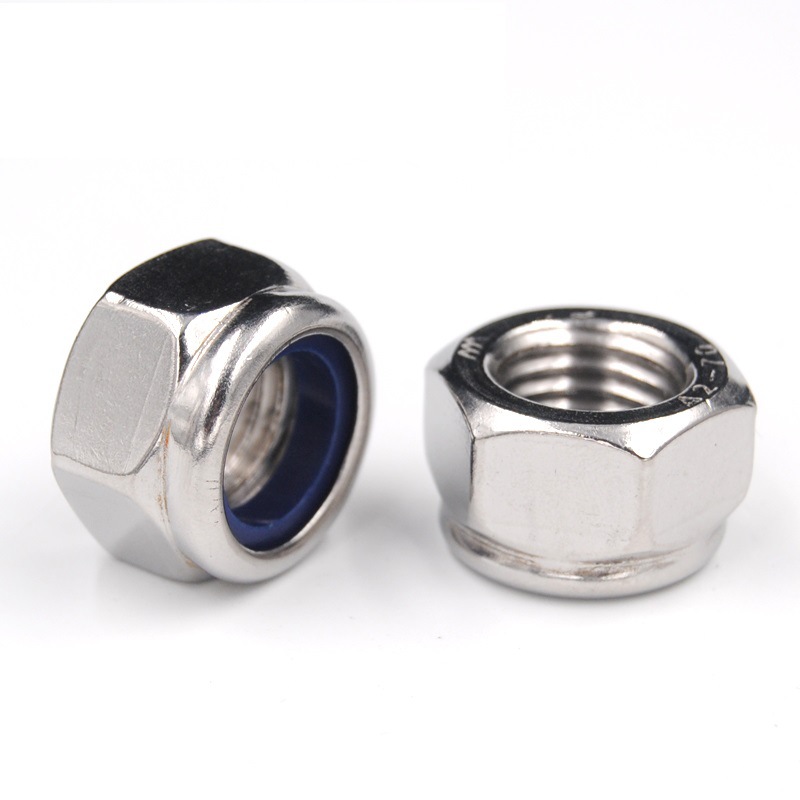
When you inspect these specialized fasteners, you immediately notice a distinct design feature. An unthreaded polymer ring sits securely captured at the top of the metal body. As you thread a bolt through the metal portion, it eventually contacts this ring. The steel bolt threads do not cut the polymer material. Instead, they plastically deform it. The polymer is softer than the steel alloy. It forces itself around the helical ridges of the bolt. This tight, compressive molding process is critical to the entire locking mechanism.
This physical deformation creates a massive compressive radial force. We refer to this continuous radial squeeze as prevailing torque. Standard fasteners operate very differently. They rely entirely on clamp load to stay secure. Clamp load is the built-up tension between the bolted joints. If parts settle, shrink, or thermally expand, joint tension disappears. A standard fastener will instantly back off under these relaxed conditions. Conversely, a nylon insert maintains its firm grip entirely independent of clamp load. It aggressively holds the bolt thread even if the surrounding joint tension drops to zero.
Additionally, the polymer material offers highly beneficial damping properties. Metals transfer shockwaves directly through a joint. The polymer absorbs these minor shocks instead. It acts as a microscopic cushion inside the threads. It dampens high-frequency kinetic energy before it causes structural fatigue. This microscopic cushioning effect drastically prevents thread fretting. Fretting often destroys standard threads over long operational periods. The polymer ensures the internal threads remain intact and secure over time.
Baseline Vibration Resistance: Where Nylon Lock Nuts Succeed
These fasteners excel in environments characterized by moderate, predictable dynamic forces. You will frequently find them securing automotive chassis components. They keep suspension linkages tight despite continuous road chatter. Consumer appliances also rely heavily on them. Washing machines and commercial dryers generate steady kinetic hums. HVAC mounting brackets use them to secure heavy roof-mounted compressors. In these specific scenarios, they offer a highly reliable and economically sound solution.
They perform exceptionally well against axial vibration. Axial forces run directly parallel to the bolt shaft. When machinery pulses, kinetic forces travel up and down the fastener axis. The compressed polymer ring effectively resists these specific vertical movements. You achieve outstanding vibration resistance without deploying complex procedures. You do not need messy chemical threadlockers. You avoid the cumbersome installation of specialized wedge-locking washers.
Their commercial advantage lies in sheer efficiency. They deliver robust security while keeping assembly simple. Production line workers install them quickly using standard hand tools. You do not have to wait for liquid adhesives to cure. You do not need to align two-piece locking washers perfectly. This operational simplicity drives down assembly times. It provides a massive advantage for high-volume manufacturing facilities.
Best Practices for Maximum Security:
Always ensure the bolt extends completely through the polymer ring.
Allow at least two full bolt threads to protrude past the top.
Avoid using high-speed impact wrenches, which can prematurely melt the polymer via friction.
Verify the bolt threads are free from sharp burrs before installation.
The Breaking Point: Known Limitations and Failure Modes
Despite their widespread industrial popularity, these fasteners have strict operational boundaries. Heat acts as their primary enemy. You must respect exact operational thresholds. The polymer ring typically begins to soften, degrade, or melt around 250°F (121°C). Once the polymer loses its structural integrity, the friction fit vanishes instantly. The part effectively becomes a standard, unsecured fastener. You must never deploy them near exhaust manifolds, boiler rooms, or high-pressure steam lines.
We must also address the dangerous reusability myth. Some manufacturers state they are technically reusable. However, strict engineering best practices dictate otherwise. The polymer deforms permanently upon the very first installation. When you remove the bolt, you tear microscopic layers of the polymer away. The inner diameter widens irreversibly. On a second use, the interference fit drops significantly. For critical, heavy-duty applications, you must treat them strictly as single-use items.
Transverse vibration presents another major vulnerability. Standard engineering benchmarks reveal this specific weakness. We use the rigorous Junker test to measure fastener security. It subjects a bolted joint to forced transverse shear displacement. Under severe side-to-side vibration, the polymer cannot hold the threads indefinitely. The fastener will incrementally back off. Mechanical locking systems handle shear forces much better.
Finally, environmental exposure degrades polymers over time. Aggressive solvents destroy the molecular bonds. Strong industrial acids eat away the ring. Prolonged UV exposure embrittles the polymer. Brittle polymers crack under torque instead of deforming smoothly. Once cracked, they offer zero resistance to dynamic loads.
Common Installation Mistakes:
Reusing the fastener after field maintenance or teardowns.
Applying thread-cutting fluids, which degrade the polymer structure.
Stopping the tightening process the moment the bolt hits the polymer ring.
Ignoring the ambient heat generated by nearby mechanical friction.
Nylon Lock Nuts vs. All-Metal Lock Nuts: Evaluating Alternatives
Engineers must often choose between polymer-insert designs and all-metal counterparts. We must contrast their materials and mechanisms carefully. All-metal versions, like Stover or Philidas styles, dominate extreme environments. They use distorted metal threads to create friction. During manufacturing, machines slightly crush the top threads. When you drive a bolt through them, the distorted steel heavily grinds against the bolt. This severe metal-on-metal friction holds the assembly together.
You should upgrade to all-metal options under specific, harsh conditions. Exhaust systems, aerospace engines, and heavy mining equipment experience extreme heat. They demand all-metal solutions. All-metal designs survive temperatures well over 1000°F. They also provide a significantly higher grip force for massive structural joints. When failure means catastrophe, all-metal designs offer superior peace of mind.
However, you should stick with polymer inserts for several distinct reasons. They drastically reduce the risk of thread galling. Galling is a highly destructive issue. It occurs when immense friction causes metal threads to cold-weld together. This happens frequently when using all-metal designs on stainless steel bolts. Once galling occurs, the fastener seizes completely. You often have to cut the bolt off with an angle grinder. The polymer provides a smooth, naturally lubricated feeling during run-down. It guarantees easy installation. It also requires lower assembly torque, preventing bolt fatigue during the initial tightening phase.
Comparison: Polymer Insert vs. All-Metal Fasteners
Performance Metric
Polymer Insert Fastener
All-Metal (Deformed Thread)
Maximum Temperature Limit
250°F (121°C)
1000°F+ (Depends on specific alloy)
Thread Galling Risk
Very Low (Self-lubricating effect)
High (Particularly on Stainless Steel)
Installation Friction
Low (Easy hand-tool assembly)
High (Often requires heavy tooling)
Standard Reusability
Not recommended (Single-use strictly)
Limited (Typically 1 to 3 cycles maximum)
Vibration Profile Fit
Moderate Axial Loads
Heavy Transverse & High-Shock Loads
Decision Framework: Securing Your Application Against Vibration
Making the right hardware choice prevents catastrophic field failures. You cannot rely on guesswork when securing heavy machinery. Follow this systematic framework to secure your design effectively.
Audit the Vibration Profile: You must determine the exact nature of the dynamic forces. Identify if your assembly faces low-frequency hums or high-frequency shock impacts. Check whether the forces are mostly axial (running up and down the bolt) or transverse (sliding side to side). If the joint experiences severe transverse shear, you must upgrade to mechanical locking washers.
Map the Operating Environment: You must check your maximum peak temperatures. Map out the ambient heat generated by nearby engines or friction sources. If temperatures routinely exceed 200°F, you risk sudden polymer degradation. Additionally, investigate potential chemical exposure. Ensure the polymer resists any localized hydraulic fluids, cleaning washdowns, or harsh environmental acids.
Factor in Maintenance Cycles: Consider exactly how often technicians will disassemble the joint. If a machine requires frequent teardowns for calibration, replacing standard fasteners every single cycle creates logistical headaches. You must weigh the hassle of constantly stocking single-use replacements against investing in heavy-duty, reusable mechanical washers. High maintenance frequencies demand a hardware strategy that minimizes downtime and labor effort.
Verify Compliance and Standardization: Ensure your selected hardware meets rigorous industry standards. Look specifically for ASME, DIN, or ISO specifications. For example, standards like DIN 985 or ISO 7040 dictate strict performance metrics. Utilizing certified hardware guarantees the fastener will deliver the exact friction limits expected by your engineering team.
By moving systematically through these four steps, you eliminate guesswork. You protect your equipment from premature failure. You ensure every joint remains tight, secure, and fully operational.
Conclusion
A polymer-insert fastener remains highly effective for standard, moderate-vibration environments. It delivers excellent axial security without complicating the assembly process. However, you must recognize it is never a blanket solution for all dynamic loads. You must firmly acknowledge its thermal limits and its vulnerability to transverse shear. We encourage engineers and buyers to match their hardware precisely to the mechanical and thermal realities of their assembly. Ignoring these strict boundaries inevitably invites failure. Take proactive steps today. Consult directly with a fastening specialist about your project requirements. Request detailed specification sheets for your intended hardware environment. Finally, always order physical testing samples to validate performance directly in your specific application.
FAQ
Q: Can you reuse a nylon lock nut on a vibrating joint?
A: We do not recommend reusing them for critical applications. The internal polymer ring deforms permanently upon its first use. When you install it a second time, it generates significantly less friction against the bolt threads. This permanent deformation dramatically increases the risk of vibration-induced loosening. Treat them strictly as single-use consumables.
Q: How does temperature affect the vibration resistance of a nylon insert?
A: Heat directly softens the polymer material. If the ambient or operating temperature exceeds the polymer’s limit, which is typically around 250°F (121°C), the interference fit completely relaxes. The material may melt. This eliminates the nut's ability to grip the bolt, instantly neutralizing its capacity to resist dynamic loads.
Q: Do I need to alter torque specifications when using a nylon lock nut?
A: Yes, you must alter your specifications. The interference fit adds rotational resistance during installation. Engineers must account for this added friction. If you rely purely on standard torque tables, the added resistance tricks your torque wrench. You will achieve a lower underlying clamp load than structurally required.