Fastener failure accounts for significant downtime in industrial machinery and catastrophic safety risks in construction. A single loose joint can halt a production line or compromise a load-bearing structure. Selecting the right fastener goes far beyond basic dimensions. You must carefully balance tensile strength, vibration resistance, and environmental compliance to ensure lasting integrity. We aim to equip procurement managers, mechanical engineers, and product designers with a strict evaluation framework. You will learn how to specify both standard and specialized fasteners based on precise load requirements and international standards. By understanding how thread pitch, material chemistry, and locking mechanisms interact, you can eliminate guesswork in your assembly processes. We will guide you through matching the exact fastener profile to your specific industry needs. Ultimately, this proactive approach prevents severe assembly delays and ensures your projects remain secure under the most demanding physical conditions.
Key Takeaways
Standardization is critical: Mixing Metric and Imperial threads or ignoring DIN/ANSI/ISO standards guarantees assembly delays and compromises joint integrity.
Material dictates lifespan: A carbon steel hex nut offers optimal high-strength properties for machinery, but specific environmental coatings (e.g., hot-dip galvanizing) are mandatory for external construction.
Application-specific profiles: Furniture requires flush, aesthetic finishes, while structural construction demands Heavy Hex profiles for maximum torque and load distribution.
Vendor capability matters: Large-scale assembly benefits from suppliers offering Vendor Managed Inventory (VMI), lot traceability, and engineering support for a custom hex nut.
1. Framing the Engineering Challenge: Load, Vibration, and Reusability
Every joint in a mechanical assembly faces physical stress. You must evaluate these failure risks before selecting any fastener. Three primary forces threaten joint integrity over time. First, thread stripping occurs when excessive torque tears the metal threads apart. Second, shear stress slices laterally across the fastener during heavy loads. Third, continuous vibration induces gradual loosening. Engineers must account for all three forces when designing a secure joint.
Standard installation torque provides baseline clamping force. However, high-vibration environments demand a deeper look at locking mechanisms. Standard nuts rely entirely on friction generated by installation torque. Prevailing-torque nuts, such as those featuring nylon inserts, add mechanical resistance. Jam nuts use a secondary, thinner profile tightened against the primary nut to prevent movement. You must consider a crucial trade-off here. A standard hex nut offers infinite reusability. Conversely, locking nuts generally require complete replacement after removal because their friction inserts degrade.
Specifying a fastener cannot happen in a vacuum. You must evaluate the entire assembly system. We call this the "washers combo" reality. You need to match the fastener grade to the bolt grade perfectly. Placing a low-grade nut on a high-tensile bolt creates a dangerous weak link. Furthermore, flat washers distribute heavy loads across wider surface areas. Lock washers add spring tension to combat vibration. This combination ensures proper load distribution and prevents physical damage to softer base materials during installation.
2. Navigating Dimensions, Thread Pitch, and Global Standards
Thread pitch discrepancies ruin production timelines. You face a critical danger if you mix Imperial threads (UNC/UNF) and Metric fasteners (M-series). UNC refers to Unified National Coarse, measuring Threads Per Inch (TPI). The Metric system measures the actual distance between individual threads in millimeters. Forcing an Imperial bolt into a Metric receiver causes immediate cross-threading. You must establish a rigid framework to standardize your facility's inventory. Dedicated, color-coded bin systems prevent costly cross-threading errors on the factory floor.
Width Across Flats (WAF) represents another critical dimension. WAF dictates the exact wrench size required for installation. This measurement directly affects tool clearance. In tight machinery housings, assemblers need adequate space to maneuver wrenches or pneumatic tools. If you ignore WAF during the design phase, field maintenance becomes nearly impossible. Mechanics will struggle to reach recessed areas, slowing down critical repairs.
Regulatory compliance provides the baseline for fastener quality. Ignoring international standards exposes your projects to massive liability. To ensure structural integrity, you must verify compliance across specific frameworks. Here is a breakdown of essential standards governing fastener manufacturing:
Standard Organization | Designation | Primary Application Focus |
DIN / ISO | DIN 934 / ISO 4032 | General engineering and global manufacturing standards. |
ASME | ASME B18.2.2 | North American industrial machinery applications. |
ASTM | ASTM A194 | High-temperature, high-pressure heavy industrial environments. |
3. Material and Finish Matrix: Matching Chemistry to the Environment
Material chemistry dictates the absolute limits of your assembly. A carbon steel hex nut remains the backbone of industrial manufacturing. However, you must navigate various strength grades carefully. Imperial systems use Grade 5 or Grade 8 designations. Metric systems rely on property classes like 8.8 or 12.9. Grade 8 and Class 12.9 provide extreme tensile strength. You must remember a key metallurgical rule: higher tensile strength often increases brittleness. You must carefully match brittle fasteners to static loads while selecting more ductile grades for dynamic, shifting loads.
Corrosion resistance introduces a complex cost-benefit analysis. Bare steel rusts rapidly when exposed to moisture. You have several finish options to extend component lifespan:
Zinc Plating: This provides a cost-effective, thin protective layer. It works perfectly for indoor machinery and commercial furniture.
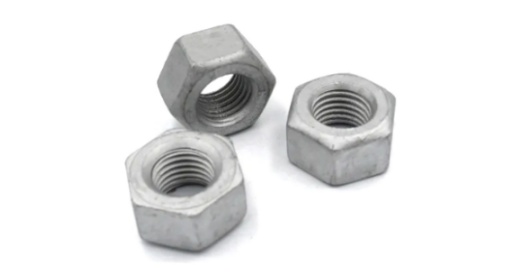
Hot-Dip Galvanized (HDG): This thick zinc coating is mandatory for outdoor construction. Because the coating adds thickness, HDG components require overtapped threads to ensure proper fitment.
Stainless Steel (304/316): These alloys offer supreme resistance to marine environments and chemical exposure. 316 stainless contains molybdenum for extra chloride protection.
When working with stainless steel, you must guard against "galling." Galling is a form of cold welding. Friction during installation causes the thread profiles to fuse permanently. To prevent this, assemblers should apply anti-seize lubricants and maintain slow, consistent installation speeds.
4. Industry-Specific Selection: Machinery, Construction, and Furniture
Different industries prioritize entirely different physical traits. Machinery and manufacturing environments deal with continuous vibration and extreme torque. In these settings, you frequently see Flange profiles. A flange base spans oversized holes and distributes heavy clamping pressure evenly. This eliminates the need for separate flat washers. Highly dynamic moving parts, such as vehicle axles, often require Castle configurations. Assemblers insert cotter pins through the castle slots to physically block the fastener from backing off under severe vibration.
Construction and structural steel sectors prioritize absolute load-bearing safety. Bridges and skyscrapers cannot rely on standard profiles. You must utilize Heavy Hex configurations for these applications. Heavy profiles feature wider WAF dimensions and thicker bodies. This added mass maximizes torque capacity and load distribution. You must pair them strictly with ASTM-rated structural bolts to maintain code compliance in steel beam connections.
To summarize these industry variations, review this application chart:
Industry Vertical | Primary Challenge | Recommended Fastener Profile |
Heavy Machinery | Continuous vibration & high torque | Flange profiles, Castle styles with pins |
Structural Construction | Massive static load & shear forces | Heavy Hex (Thicker, wider profiles) |
Consumer Furniture | Aesthetics & snag prevention | Barrel types, Cap styles, flush designs |
Commercial furniture and consumer goods require a totally different approach. You must focus on low-profile assembly and visual aesthetics. Exposed threads pose a safety hazard for end users. To resolve this, manufacturers pair basic internal fasteners with barrel and cap styles. Cap designs feature a domed top to cover exposed thread ends. Custom low-profile designs prevent clothing snags while maintaining necessary structural rigidity.
5. Vendor Shortlisting: From Standard Volume to Custom Hex Nut Solutions
Securing a reliable supply chain requires strict vendor evaluation. You cannot accept quality claims without concrete documentation. Start by assessing their Quality Control (QC) and lot traceability. Authoritative testing validates structural integrity. Request proof of tensile testing for structural components and salt-spray testing for anti-corrosion coatings. Adherence to ISO 9001 demonstrates a baseline commitment to process control. You should demand batch-level Material Test Reports (MTRs) before approving any large-scale purchase.
Sometimes, an off-the-shelf standard hex nut fails to meet specific engineering criteria. You may face unique tool clearance limitations or require specialized alloys. In these instances, you must partner with a supplier capable of rapid prototyping. When you initiate a custom hex nut request, clearly specify your requirements. Detail the required thread accuracy, custom plating thickness, or necessary tamper-resistant features. A capable vendor will provide engineering support to refine these designs before full production.
Finally, evaluate vendors based on operational scalability. Supply chain integration separates good suppliers from great partners. Large-scale assembly lines suffer when bins run empty. Assess their ability to provide Vendor Managed Inventory (VMI) services. VMI allows the supplier to monitor and restock your inventory automatically. Seek out partners offering custom kitting and automated barcode labeling. These value-added services eliminate factory floor bottlenecks, reduce procurement overhead, and streamline your entire manufacturing operation.
Conclusion
Selecting the right fastener requires a rigorous review of operational loads, environmental threats, and assembly-line realities.
Matching the specific material grade and protective coating to your environment prevents premature joint failure and costly downtime.
Evaluating vendor capabilities, including quality documentation and custom engineering support, ensures long-term supply chain stability.
As a next step, advise your procurement and engineering teams to audit current failure rates on the factory floor. Standardize your metric and imperial storage bins immediately to prevent cross-threading errors. Finally, always request physical prototypes and comprehensive Material Test Reports from potential supply partners before committing to volume orders.
FAQ
Q: Can I substitute a standard hex nut for a heavy hex nut?
A: No. Heavy hex profiles feature a wider Width Across Flats (WAF) and greater thickness. They provide larger bearing surfaces and higher proof loads. Structural integrity is severely compromised if you substitute them incorrectly in load-bearing construction applications.
Q: Are hex nuts reusable after exposure to high-vibration environments?
A: Standard types are generally reusable if threads pass visual inspection. However, prevailing-torque options (like nylon insert lock nuts) lose their critical friction integrity after one use. You must discard and replace them upon removal to ensure safety.
Q: How do I prevent stainless steel hex nuts from seizing during installation?
A: Stainless steel is highly prone to galling, a form of cold welding caused by friction. You can prevent seizing by applying anti-seize thread lubricants before assembly and maintaining a slow, steady installation speed without using impact tools.
Q: What is the difference between fine thread and coarse thread hex nuts?
A: Coarse threads feature fewer threads per inch. They assemble faster, resist cross-threading, and perform better in soft materials. Fine threads offer a larger stress area, providing higher tension strength and superior resistance to vibration-induced loosening.


